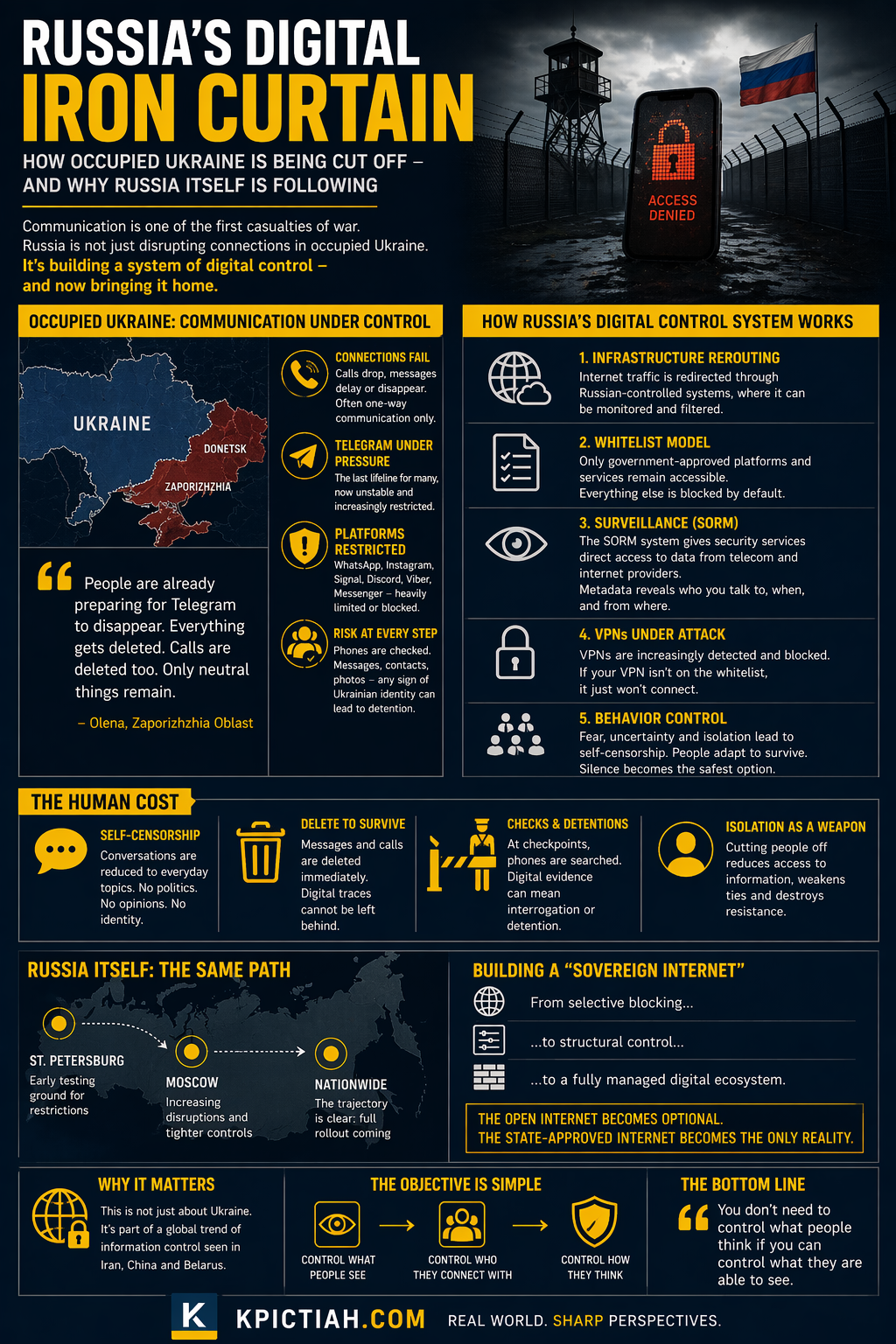
How occupied Ukraine is being cut off and why Russia itself is following
Real world. Sharp perspectives.
War is often measured in territory, weapons, and casualties.
But some of the most decisive battles are invisible.
They happen in cables. In servers. In silence.
Across Russian-occupied territories of Ukraine, a different kind of system is taking shape, one that doesn’t just restrict information, but redefines how reality is accessed, shared, and even perceived.
What is emerging is not simply censorship, but it is the construction of a controlled digital environment, one that is increasingly being replicated inside Russia itself.
The slow collapse of communication
For Ukrainians separated by the front line, communication has always been fragile. But in recent months, it has become something else entirely:
👉 Unreliable
👉 One-sided
👉 Risky
Residents in Ukrainian-controlled areas describe a growing inability to reach family members in occupied regions such as Donetsk and Zaporizhzhia.
Calls fail. Messages arrive hours late, or not at all. Connections drop without explanation.
For many, Telegram has been the last functioning bridge between two worlds. But even that bridge is now unstable.
In some cases, communication has become one-directional: relatives in occupied areas can call out, but cannot be called.
That asymmetry is not technical, butIt is controlled.
From censorship to architecture
In the early phases of the war, Russian control over the internet followed a familiar model:
- Block certain websites
- Restrict specific platforms
- Filter selected content
But that approach has evolved. Today, Russia is no longer just censoring the internet, but it is rebuilding it.
Instead of blocking access to unwanted platforms, the system is shifting toward something far more restrictive:
👉 A whitelist-based model
In this system:
- Only government-approved services function
- Everything else is inaccessible by default
- Users are no longer navigating an open internet, but a curated environment
This is a fundamental shift.
The question is no longer “what is blocked?” The question becomes: what is allowed?
Infrastructure as control
This transformation is made possible by control over infrastructure.
Internet traffic in occupied territories is being:
- Rerouted through Russian-controlled networks
- Processed through domestic filtering systems
- Monitored before reaching users
As cybersecurity experts explain, Russia doesn’t need to physically replace cables.
It simply changes where they lead.
The result is a system where:
- Access can be restricted in real time
- Platforms can be degraded instead of fully blocked
- Users can be monitored without their awareness
It is subtle, but it is extremely effective.
Surveillance at scale
At the core of this system lies a powerful tool: SORM (System for Operative Investigative Activities).
This state-mandated framework allows Russian security services to:
- Access telecom and internet traffic directly
- Link online behavior to individual users
- Monitor activity at the provider level
Even when content is encrypted, metadata remains visible:
- Who you communicate with
- When
- How often
- From where
In controlled environments, that is often enough. Because control is not just about content, but it is about patterns.
The end of private conversation
The result is a profound shift in behavior.
People are not simply restricted, they are adapting.
And that adaptation takes a very specific form:
👉 Self-censorship
Residents in occupied areas describe routines that have become second nature:
- Messages are deleted immediately after reading
- Calls are erased from history
- Conversations are reduced to neutral, everyday topics
No politics.
No opinions.
No identity.
Just enough communication to maintain the illusion of normal life.
Behind that behavior lies a constant calculation:
👉 What can be said without risk?
Because the consequences are real.
Phones are checked at checkpoints.
Digital traces are examined.
Even indirect signs of Ukrainian identity can trigger questioning or detention.
The psychological dimension
This is where digital control becomes something more than technical.
It becomes psychological.
By limiting communication, authorities achieve several things at once:
- They reduce access to independent information
- They weaken personal connections across the front line
- They increase uncertainty and isolation
Over time, this creates an environment where:
👉 Reality becomes fragmented
👉 Trust erodes
👉 Fear becomes internalized
People no longer need to be actively silenced.
They begin to silence themselves.
A system designed for control, not efficiency
From a purely economic or technological perspective, this approach is inefficient.
It:
- Slows down communication
- Limits access to global platforms
- Frustrates users
But efficiency is not the goal.
Control is.
As long as dissatisfaction does not translate into organized resistance, the system functions exactly as intended.
The wider strategy: forced social engineering
Experts describe this approach as a form of forced social engineering.
The objective is not just to block information, but to reshape it.
To:
- Align perception with state narratives
- Reduce exposure to alternative viewpoints
- Gradually redefine what is considered “normal”
In occupied territories, this process is accelerated.
Because control is easier to impose in environments where:
- Infrastructure is already disrupted
- Institutions are weakened
- Populations are under pressure
From occupied territories to Russia itself
What makes this development particularly significant is that it is not confined to Ukraine.
The same logic is increasingly visible inside Russia.
Over the past years, the Kremlin has been moving toward what is often referred to as a “sovereign internet” — a system designed to function independently from the global web.
Recent developments suggest that this transition is accelerating.
Early signals: regional testing
Cities like St. Petersburg have seen:
- Localized internet slowdowns
- Platform disruptions
- Increased filtering
These are not random failures.
They are tests. Controlled environments where new restrictions can be implemented, adjusted, and refined.
Expanding control in Moscow
Even in Russia’s capital, signs of tightening control are becoming visible:
- VPN services are increasingly unreliable
- Access to foreign platforms is less stable
- State-approved alternatives are being promoted
This mirrors the pattern seen in occupied territories, though at a slower pace.
The trajectory: from open to controlled
The direction is clear.
Russia is moving from:
- Selective blocking
- To structural control
- To a fully managed digital ecosystem
A system where:
👉 The global internet becomes optional
👉 The domestic version becomes dominant
And eventually:
👉 The domestic version becomes the only version
Why this matters beyond Russia and Ukraine
This is not an isolated development.
It reflects a broader global trend toward:
- Fragmentation of the internet
- Rise of controlled digital ecosystems
- Increasing use of information as a tool of power
Countries such as China, Iran, and Belarus have already developed similar models.
Russia is now building its own version, with the added dimension of active conflict.
Isolation as a strategic tool
At its core, this strategy is simple.
Control communication → control coordination → control outcomes.
By limiting:
- What people see
- What they can access
- Who they can talk to
Authorities reduce the possibility of:
👉 Collective action
👉 Organized resistance
👉 Alternative narratives
And that is the real objective.
Conclusion: a new kind of battlefield
The war in Ukraine is not only being fought with tanks, artillery, and drones.
It is also being fought through:
- Networks
- Algorithms
- Access
The physical front line divides territory. The digital front line divides reality.
You don’t need to control what people think if you can control what they are able to see.
About the Author