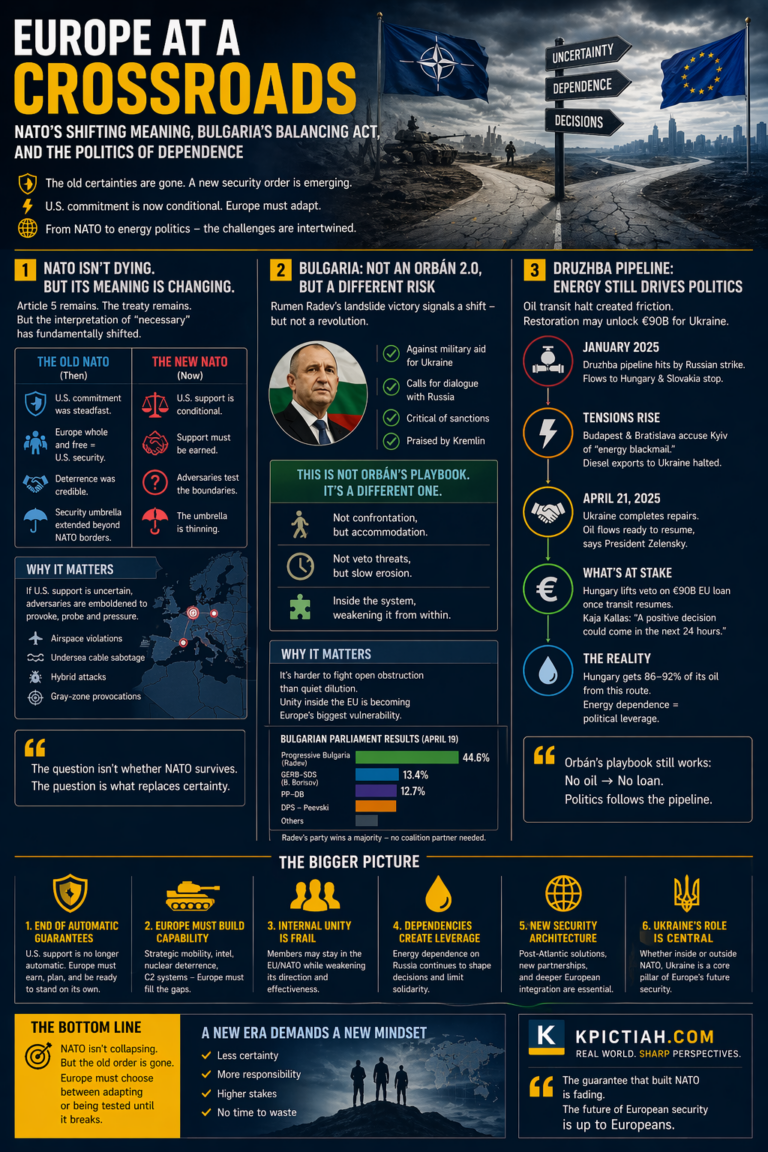
As diplomatic activity around Ukraine accelerates, one uncomfortable truth is becoming impossible to ignore: peace without credible power is not peace at all. It is a pause, one that Russia will use to reload, regroup, and strike again.
Recent developments point to a familiar pattern. The United States and Europe are exploring “Article 5-like” security guarantees for Ukraine, while at the same time insisting that no American troops will ever be deployed on Ukrainian soil. Behind closed doors, Washington is also increasing pressure on Kyiv to consider territorial concessions, even as Moscow openly signals it has no intention of ending the war.
The gap between Western rhetoric and Russian reality is widening and that gap is dangerous.
High-Tech deterrence instead of boots on the ground
The U.S. has made one thing clear: American soldiers will not defend Ukraine directly, even after a peace deal. Instead, Washington and its allies are quietly preparing a deterrence model based on advanced military capabilities stationed in NATO countries surrounding Ukraine.
According to diplomatic sources, this would include:
- F-35 fighter jets providing air dominance and rapid-response capability
- Advanced intelligence, surveillance, and targeting support
- And potentially, long-range Tomahawk cruise missiles as a strategic “lock on the door”
These systems would not be deployed inside Ukraine, but around it, creating a security ring designed to raise the cost of renewed Russian aggression.
Crucially, the proposed peace framework places no formal limits on the weapons Ukraine may possess for self-defense. This directly contradicts Vladimir Putin’s long-standing demand that Ukraine be barred from missiles capable of reaching Moscow or St. Petersburg, a demand the West increasingly appears unwilling to honor.
Putin’s response: open contempt for peace
Any illusion that Moscow is preparing for compromise was shattered when Putin publicly lashed out at European leaders, calling them “pigs” and declaring that Russia would “liberate historical territories on the battlefield.”
The message could not be clearer:
- Ukraine is not recognized as a sovereign state
- Compromise is rejected outright
- War, not negotiation, remains the Kremlin’s chosen tool
Putin has stated he will only talk to the United States and only if all Russian demands are met. The EU, in his words, is irrelevant unless its political leadership is replaced.
This rhetoric was delivered while awarding medals to Russian “war heroes” and as Defense Minister Andrei Belousov vowed to increase the pace of Russia’s military advance next year.
Zelensky’s response was blunt: these signals are not just meant for Ukraine, but for the West, especially Washington. And they require a reaction, not interpretation.
The mirage of “Article 5-Like” guarantees
With NATO membership off the table, Ukraine is being offered a substitute: security guarantees modeled on NATO’s Article 5, but without NATO itself.
On paper, the idea sounds reassuring. In practice, it is deeply flawed.
Under the current proposal:
- A European-led force would assist with air, sea, and rear-area security
- The U.S. would provide intelligence and monitoring support
- Partners would commit, vaguely, to “restore security” if Russia attacks again
But here’s the problem: Article 5 works because it is institutional, automatic, and backed by overwhelming force. Strip away the institution, the clarity, and the certainty and what remains is ambiguity.
As Ukrainian MP Oleksandr Merezhko warned, anything less risks repeating the Budapest Memorandum: promises that evaporate when they are tested.
Even experts sympathetic to the idea admit the credibility problem. If Russia believed the guarantees were real, it would reject them outright. The fact that Moscow continues engaging suggests it does not believe the West would actually enforce them.
Can Trump be trusted to enforce them?
This question hangs over every discussion.
Zelensky has pushed for guarantees certified by the U.S. Congress, signaling a lack of confidence in presidential promises alone. The concern is not hypothetical.
Trump has:
- Publicly questioned defending NATO members who spend “too little”
- Threatened to disengage from NATO structures after 2027
- Shown willingness to ignore or sidestep congressional constraints
If even NATO’s Article 5 feels less ironclad today, what does that say about an informal, bespoke version designed for Ukraine?
Experts point to the Taiwan Relations Act as a possible model, embedding concrete obligations and congressional oversight. But even legislation is no guarantee against political will.
Talks in Miami, pressure on Kyiv
Against this backdrop, U.S. and Russian officials are set to meet in Miami, led by Trump’s special envoy Steve Witkoff and Jared Kushner, with Russia represented by Kirill Dmitriev.
These talks follow consultations in Berlin where Washington reportedly pressed Kyiv to show flexibility on territory, even as Russia insists on full control of Donbas.
Zelensky’s position remains unchanged:
“They want our Donbas. And we do not want to give away our Donbas.”
The risk is obvious. Negotiations driven by Western fatigue rather than Russian defeat reward aggression and confirm the Kremlin’s belief that time is on its side.
Why deterrence must be real and why Russia must lose
Russia does not respect intentions. It respects power, clarity, and consequences.
Any peace framework that:
- Avoids troop commitments
- Relies on ambiguous guarantees
- Restricts Ukraine’s ability to strike back
- Or pressures Kyiv into territorial concessions
…is not a peace plan. It is a deferred conflict.
Real deterrence means ensuring Russia knows, beyond doubt, that renewed aggression will fail militarily and economically. That requires:
- A strong Ukrainian army with unrestricted defensive capabilities
- Deep-strike systems that threaten Russia’s war economy
- Western unity that does not fracture at the first escalation threat
Ukraine is not asking the West to fight its war. It is asking for the means to win it, so it never has to be fought again.
Peace without power is a lie. And Russia has made it abundantly clear: if it is not stopped, it will return.
About the Author