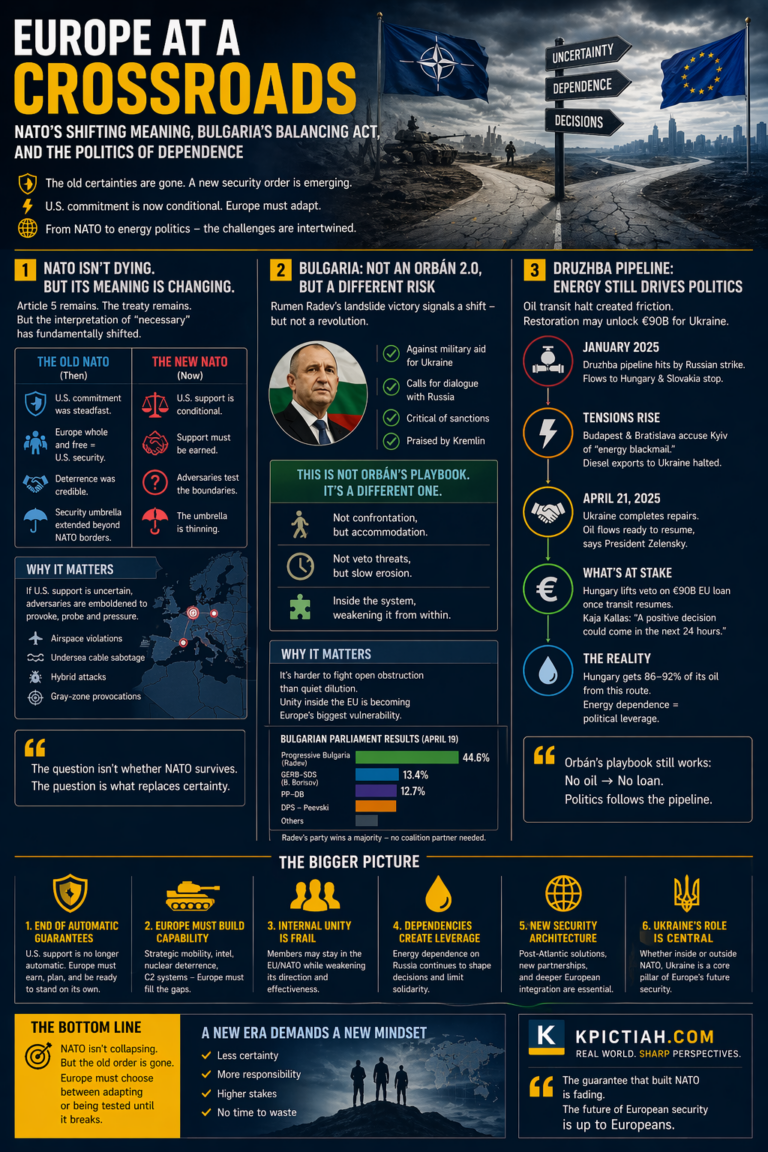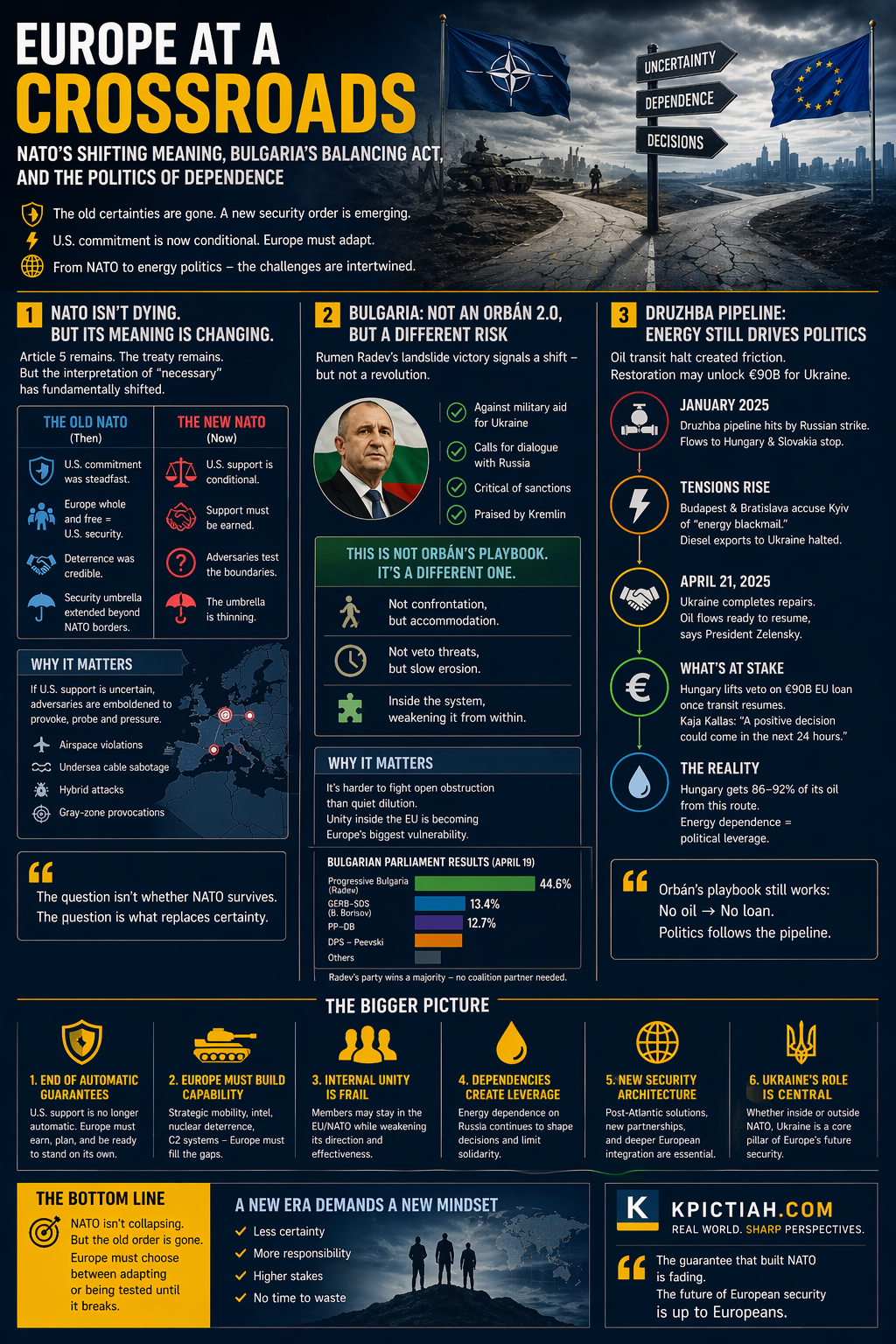
NATO’s shifting meaning, Bulgaria’s balancing act, and the politics of dependence
Real world. Sharp perspectives.
For decades, Europe outsourced its security to certainty. That certainty had a name: the United States.
And its guarantee was simple: if Europe is threatened, America responds.
Today, that certainty is cracking. Not because NATO is collapsing, but because its meaning is changing.
And once meaning changes, everything else follows.
NATO isn’t dying, but it’s transforming
Every time Donald Trump questions NATO, the same debate resurfaces:
👉 Is this the end of the alliance?
The answer is both simpler and more uncomfortable.
No, NATO is not ending. But yes, the NATO we knew is already gone.
The treaty still exists.
Article 5 still stands.
Military cooperation continues.
But the assumption behind it has shifted.
The word that changed everything: “necessary”
At the core of NATO lies a deceptively flexible word:
👉 “necessary”
Article 5 does not mandate how the United States responds.
It leaves that decision to political judgment.
For decades, that judgment was predictable:
- European security = American security
- Therefore → intervention was “necessary”
That was the unwritten rule.
Trump shattered it.
A transactional alliance
Under the Trump doctrine, “necessary” is no longer automatic.
It becomes conditional.
👉 Conditional on European behavior
👉 Conditional on alignment with U.S. interests
👉 Conditional on reciprocity
In simple terms:
If Europe wants protection, Europe must earn it.
That changes everything.
Because it turns NATO from:
➡️ A guarantee
into
➡️ A negotiation
Why this matters more than people admit
Many European leaders still point to:
- Military coordination
- Joint exercises
- Institutional continuity
But they’re missing the point. All of that is operational, but the real shift is strategic.
If adversaries believe U.S. support is uncertain, they don’t need to defeat NATO.
They just need to test it.
And they already are.
Testing the cracks
Across Europe, the pattern is clear:
- Undersea cables sabotaged
- Airspace violations
- Hybrid attacks
- Gray-zone provocations
From Estonia to Ireland.
From the Arctic to the Mediterranean.
These are not accidents.
They are probes.
The invisible umbrella is fading
For years, NATO’s strength extended beyond its borders.
Even non-members benefited from:
👉 The assumption of U.S. escalation
👉 The credibility of American deterrence
That “umbrella” made Europe safer than its formal structure suggested.
Now that umbrella is thinning.
And suddenly:
- Non-NATO states look vulnerable
- Border regions look exposed
- Gray zones look exploitable
Europe’s uncomfortable realization
Europe is slowly reaching a conclusion it avoided for decades:
👉 It must be able to defend itself.
Not as a complement to the U.S. but as a fallback without it.
That means:
- Strategic mobility
- Intelligence capabilities
- Nuclear deterrence discussions
- Independent command structures
Things Europe was once told not to duplicate.
Now? They are no longer “unnecessary.”
They are essential.
Bulgaria: a preview of Europe’s internal challenge
While NATO’s external credibility is shifting, Europe faces another problem:
👉 Internal fragmentation
The recent election victory of Rumen Radev in Bulgaria is a perfect example.
At first glance, it looks familiar:
- Skepticism toward Ukraine
- Calls for dialogue with Russia
- Opposition to military aid
The immediate fear: another Orbán
But that’s too simplistic.
Not confrontation, but erosion
Radev is not likely to openly block EU policy.
He represents something more subtle and arguably more dangerous:
👉 Passive resistance
- Slower decisions
- Less enthusiasm
- Quiet alignment with Russian interests
Not disruption, but dilution.
The new European risk model
The EU is no longer dealing with outright obstruction alone.
It is dealing with:
👉 Governments that remain inside the system
👉 While gradually weakening its direction
This creates a different kind of vulnerability:
- Harder to confront
- Easier to normalize
- Slower to detect
And over time, just as effective.
Energy: the leverage that never disappeared
Despite years of diversification efforts, reality remains:
- Hungary depends heavily on Russian oil
- Slovakia relies almost entirely on it
- Bulgaria is still entangled in Russian energy structures
And that brings us to the Druzhba pipeline.
Ukraine’s strategic dilemma: survival vs leverage
When Ukraine halted oil transit through Druzhba after a Russian strike, tensions escalated quickly.
Hungary and Slovakia responded with:
👉 Accusations of “energy blackmail”
👉 Retaliatory measures
👉 Political pressure in Brussels
Ukraine faced a difficult choice:
- Maintain pressure on Russia
or - Maintain unity with Europe
It chose the latter.
The pipeline is back, but at a price
With repairs completed, oil flows are set to resume.
This unlocks:
👉 A €90 billion EU loan
👉 Political goodwill
👉 Reduced tension with Hungary and Slovakia
But it also exposes a deeper truth: Europe is still negotiating with itself.
Orbán’s playbook still works
Hungary’s position was clear:
👉 No oil → no loan
And it worked.
Once transit resumes, the veto disappears.
This is not a side story.
It is the system.
The bigger picture: dependence shapes policy
Europe’s geopolitical stance is still influenced by:
- Energy dependencies
- Internal divisions
- Strategic uncertainty
Which leads to a fundamental question:
👉 Can Europe act as a unified power when its interests are not fully aligned?
A post-Atlantic future?
If U.S. commitment becomes conditional and European unity becomes fragile.. Then the future of European security will not be defined by NATO alone.
It will be defined by:
👉 What Europe builds next
This may include:
- Deeper EU defense integration
- New security partnerships
- Closer ties with countries like Ukraine and Moldova
- A hybrid system beyond NATO
Ukraine’s role in this new reality
Ironically, Ukraine may become more central to European security outside NATO than inside it.
Because what matters is no longer just membership.
It is:
👉 Integration
👉 Capability
👉 Alignment
Ukraine is already:
- Battle-tested
- Militarily experienced
- Strategically vital
Final thought: NATO’s obituary is premature, but the old order is gone
NATO is not collapsing, but it is no longer what it was.
And pretending otherwise is dangerous, because Europe is entering a new phase:
👉 Less certainty
👉 More responsibility
👉 Higher stakes
NATO isn’t dying, but the guarantee that built it already has.
And Europe is only just beginning to understand what that really means.
About the Author