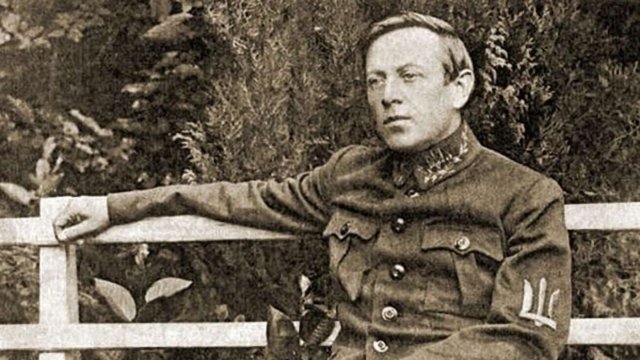
🕯️ On May 25, 1926, Ukrainian President Symon Petliura was assassinated in Paris by a Soviet agent in one of the Kremlin’s most calculated political murders of the 20th century. Now, 99 years later, the legacy of that operation still casts a long shadow — not just over Ukrainian history, but over the tactics of disinformation, political assassination, and character assassination still used by the Kremlin to this day.
Who Was Symon Petliura?
Symon Petliura (1879–1926) was a Ukrainian statesman, publicist, and military leader who served as the head of the Directorate of the Ukrainian People’s Republic (UNR) — Ukraine’s short-lived attempt at modern independence between 1918 and 1921. As the Commander-in-Chief of the UNR’s armed forces, Petliura led the struggle for Ukrainian sovereignty against both the advancing Bolshevik Red Army and the reactionary Russian White Army.
A fierce advocate for Ukrainian independence, Petliura sought international alliances, including a military pact with Poland, to counteract the Russian threat. He aimed to establish a democratic Ukrainian republic — secular, pluralistic, and modern — in a time of great political chaos across Eastern Europe.
The Paris Assassination
On May 25, 1926, while living in exile in Paris, Petliura was gunned down on the street by Solomon Schwartzbard, a Soviet GPU (State Political Directorate) agent. Schwartzbard claimed to be a “Jewish avenger,” holding Petliura responsible for anti-Jewish pogroms that occurred during Ukraine’s war of independence. But later archival research and historical analysis suggest this narrative was a Soviet cover story — a well-designed operation by Soviet intelligence to neutralize a prominent figure in the Ukrainian independence movement.
Volodymyr Burchak, a historian and current serviceman in Ukraine’s National Guard, uncovered compelling archival evidence supporting this interpretation. “The Soviet special operation was carefully designed to appear as if a Jew had killed an ‘anti-Semite’ in revenge for pogroms,” Burchak writes. “This narrative was a fabrication.”
Pogroms and the Historical Record
The Russian Empire, and later the Soviet regime, weaponized the accusation of antisemitism to discredit nationalist movements — particularly in Ukraine. While pogroms did tragically occur during the chaotic civil war years of 1918–1920, Petliura’s personal role has been grossly misrepresented.
Petliura did not initiate or condone such violence. In fact, he issued multiple public decrees condemning pogroms, ordered executions of those responsible within his ranks, and worked to incorporate Jewish communities into the political framework of the UNR. Over 20% of his government and military administration included Jewish representatives. Yiddish was recognized as a state language. Currency issued by the UNR featured both Ukrainian and Hebrew text.
Blaming Petliura for the violence of the civil war is akin to blaming Abraham Lincoln for every crime committed by Union troops. It is both reductive and politically motivated.
A Pattern of Erasure
The Soviet Union — and the modern Russian state that inherited its security doctrines — has long followed a playbook of physical and historical erasure. First, kill the leader. Then kill the truth.
They did this with Petliura. They did it with Bandera. And today, they attempt the same with President Volodymyr Zelensky — painting a Jewish Ukrainian president leading a multiethnic democracy as a “Nazi” to justify imperial aggression.
It is a familiar pattern: assassinate a patriot, rewrite the narrative, and silence dissent. But truth, even when buried, eventually finds its way to the surface.
Remembering Petliura
Symon Petliura was not perfect. No revolutionary leader ever is. But he dedicated his life to the dream of a free and independent Ukraine and paid for that dream with his life. His death in Paris was not just a murder; it was a message from Moscow that Ukrainian independence would be punished.
Nearly a century later, Ukraine is still fighting the same empire. And the same empire still believes it can eliminate Ukraine’s future by erasing its past.
But Ukraine remembers. We remember Petliura — and we remember who pulled the trigger.
The empire failed then. It will fail again.
About the Author