Ukraine’s fight for independence did not start in 2022.
It did not even start in 2014.
It is a story that stretches back over a century and today, it is being fought not only on battlefields, but in cities, in societies, and in the geopolitical balance of Europe.
A nation that never stopped fighting
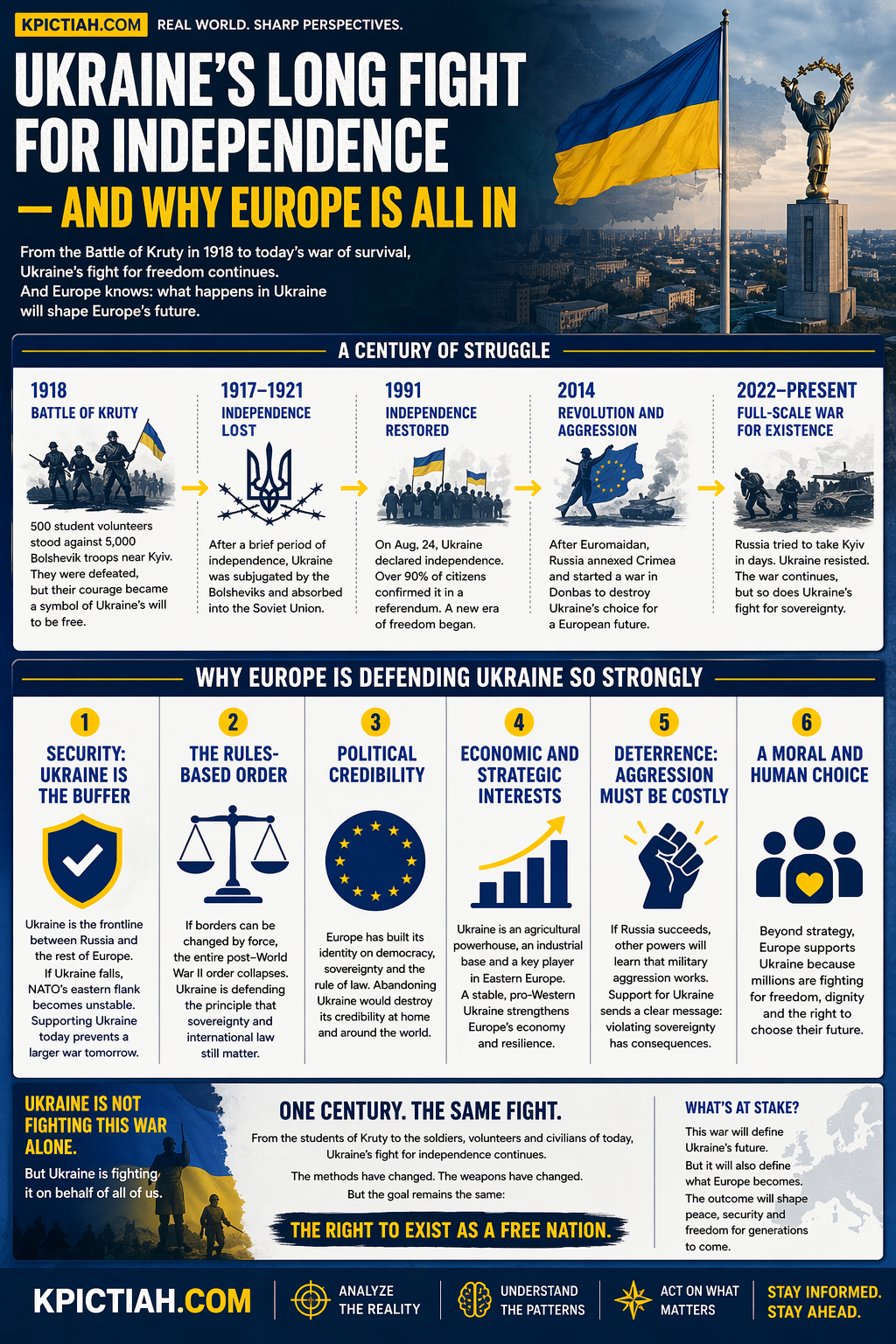
On a freezing day in 1918, around 500 Ukrainian students stood near Kyiv, digging trenches.
They knew what was coming.
Roughly 5,000 Bolshevik troops were advancing. The battle that followed, the Battle of Kruty, was never meant to be won. It was meant to delay.
And it did.
The students were defeated, many executed. One of them reportedly sang Ukraine’s national anthem before being shot, an act of defiance that would echo through generations.
Ukraine would lose its independence soon after, absorbed into the Soviet system. But the idea of independence never disappeared.
Independence delayed, not denied
When the Soviet Union began to collapse, Ukraine seized its moment.
On August 24, 1991, Ukraine declared independence. Months later, over 90% of voters confirmed it in a referendum. The Soviet Union dissolved shortly after.
For the first time in modern history, Ukraine existed as a fully sovereign state.
But independence came with instability.
The economy collapsed. Institutions were fragile. And Russia never truly accepted Ukraine as independent.
That tension never went away.
From revolution to war
The breaking point came during the Euromaidan Revolution.
Ukrainians made a clear choice: move toward Europe, away from Moscow.
Russia responded the only way it historically has when losing control:
- Annexing Crimea
- Fueling war in Donbas
- Undermining Ukrainian sovereignty
In 2022, Vladimir Putin escalated this into a full-scale invasion.
The plan was simple: take Kyiv in days, install a puppet regime, erase Ukraine as a state.
That plan failed.
War in 2026: adaptation and survival
Fast forward to today, and the war has evolved.
In cities like Izium, just tens of kilometers from the front, life continues, but under constant threat.
Above the streets, anti-drone nets stretch like artificial ceilings. They are not advanced technology. They are improvisation.
A response to a new reality: cheap, fast, deadly FPV drones.
Modern warfare has changed:
- Roads are no longer safe
- Supply lines are constantly targeted
- Even rear areas are exposed
The nets help, but only partially.
Because drones are just one layer of a much broader Russian strike system that includes glide bombs, Lancet drones, and heavy aerial attacks.
There is no single solution.
The psychological front
War is not just physical. It is psychological.
Civilians adapt, because they have to.
Children grow up fearing sounds most people would not even recognize. Families live under visible reminders of danger. Soldiers acknowledge that even when defenses improve, the threat evolves faster.
And perhaps the most dangerous shift of all:
People get used to it.
Normalization is survival, but also a silent cost of war.
Why Europe is defending Ukraine so strongly
This is where the story expands beyond Ukraine.
Europe is not supporting Ukraine out of charity.
It is acting out of self-interest.
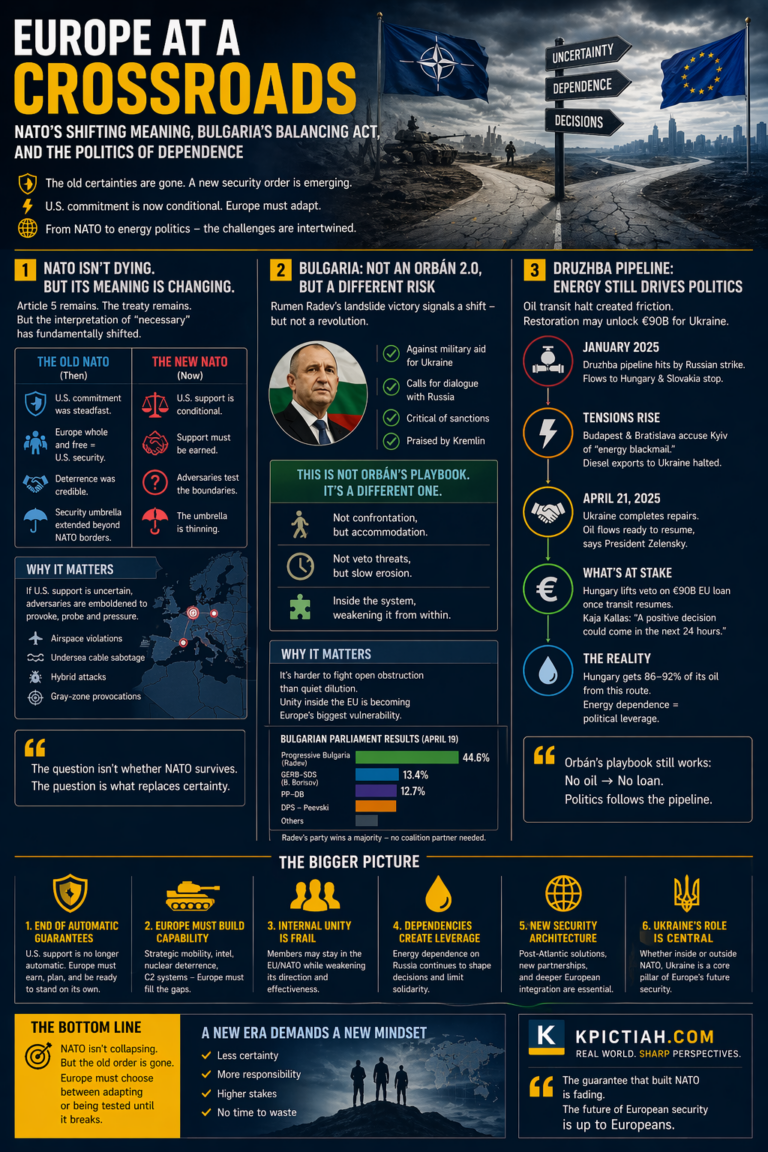
1. Security: Ukraine is the buffer
Ukraine is effectively the frontline between Russia and the rest of Europe.
If Ukraine falls, the geopolitical consequences are immediate:
- Russian influence moves west
- NATO’s eastern flank becomes unstable
- Countries like Poland and the Baltic states face direct pressure
Supporting Ukraine is cheaper, and safer, than confronting Russia later.
2. The rules-based order
If borders can be changed by force, the entire post-World War II European order collapses.
Ukraine is not just defending its territory.
It is defending the principle that countries cannot simply invade neighbors and redraw maps.
If that principle fails, it won’t stop in Ukraine.
3. Political credibility
Europe, and especially the EU, has positioned itself as a bloc built on democracy, sovereignty, and rule of law.
If it abandons Ukraine after openly supporting it, that credibility disappears overnight.
Globally, that matters.
4. Economic and strategic interests
Ukraine is not a minor player:
- Massive agricultural capacity
- Significant industrial base
- Strategic position in Eastern Europe
A stable, Western-aligned Ukraine strengthens Europe economically and geopolitically.
A Russian-controlled Ukraine does the opposite.
5. Deterrence
Supporting Ukraine sends a message: aggression will be costly.
If Russia succeeds, it signals to other powers, globally, that military expansion works.
That is not a precedent Europe can afford.
The uncomfortable reality
Ukraine is not just fighting for itself.
It is fighting a war that Europe has decided it cannot afford to lose without directly fighting it.
And that creates a paradox:
- Ukraine bears the human cost
- Europe bears the financial and strategic cost
But both are deeply invested in the outcome.
A century later, the same fight
More than 100 years after the students at Kruty stood against a much larger force, Ukraine is once again fighting for the same thing:
The right to exist as an independent nation.
The methods have changed.
The stakes have increased.
But the core conflict remains identical.
Independence is not a one-time achievement.
For Ukraine, it is a continuous struggle.
Conclusion: This war defines Europe’s future
This war will not just determine Ukraine’s future.
It will determine what Europe becomes:
- A continent that defends its principles
- Or one that compromises when challenged
Ukraine is the battlefield.
But the outcome will shape the entire continent.
About the Author